


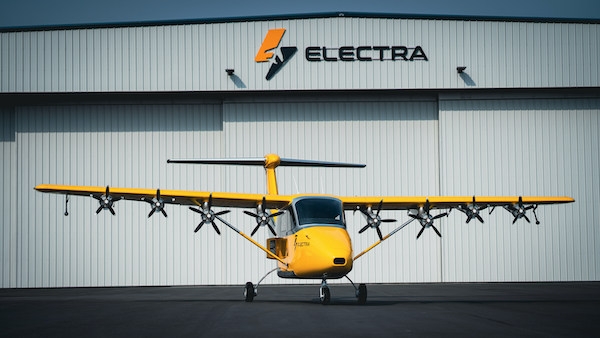
Electra.aero unveiled the test vehicle for its hybrid-electric ultra eSTOL aircraft marking a significant milestone in Electra mission to help decarbonize aviation and revolutionize urban and regional transportation. Electra eSTOL technology demonstrator is world' first blown lift aircraft using distributed electric propulsion, which enables the airplane to take off and land in very short spaces. Electra's proprietary blown lift technology uses eight motors to provide additional wing lift, and hybrid-electric power that provides internal recharging capabilities for aircraft batteries, eliminating the need for new ground infrastructure.
The two-seat piloted TD aircraft showcases the Electra eSTOL technology at full scale and will be flown this summer in an extensive flight test program to track performance and inform the design of Electra's 9-passenger production aircraft. The company conducted a fully integrated test of its proprietary hybrid-electric propulsion system last year.
John S. Langford, Founder and CEO of Electra.aero commented: "In the three years since we founded Electra, we've designed our eSTOL aircraft, validated our blown lift technology with a sub-scale demonstrator, and run a fully integrated test of our 150-kilowatt hybrid-electric generator at full scale. Now we're ready to test the entire system with this technology demonstrator aircraft. We can't wait to fly this plane and show the world what our eSTOL aircraft can do."
JP Stewart, Electra Vice President and General Manager said: "Electra was founded to build electric aircraft that make sense. We are meeting market demand for cleaner, cost-effective aircraft that can fly people and cargo closer to where they want to go, and this technology demonstrator aircraft will prove that our eSTOL technology makes that possible."
Electra future eSTOL production aircraft will deliver the operational flexibility of a helicopter with the safety and economics of a conventional fixed-wing aircraft. Electra plans to fly a prototype of the 9-passenger production aircraft in 2025, with certification and entry into service in 2028 under FAA Part 23 regulation. Electra has designed the eSTOL aircraft so that hydrogen or battery-electric propulsion systems can be used in the future when those technologies are commercially viable.
Electra currently holds letters of intent from more than 30 customers for over 1200 of its 9-passenger production eSTOL aircraft, totaling more than $4 billion in market demand. The company recently won a $30 million U.S. Air Force funding award as part of a larger $85 million funding effort. The aircraft was rolled out at Electra's development facility at the Manassas, Virginia Regional Airport in a ceremony that included guests from the aviation industry, government, the investor community, and Electra customers.
Dassault will introduce the fourth-generation EASy IV flight deck on newly built Falcon 2000LXS aircraft, while also making the upgrade available as a retrofit across the entire Falcon 2000 EASy fleet...
Bombardier marked the 40th anniversary of its industry-leading Smart Services cost-per-flight-hour programs, which today support more than 1,500 enrolled aircraft and account for over 11 mil...
Airbus 2026 Cargo Global Market Forecast, unveiled at the Cargo Facts Symposium, predicts that the global fleet of dedicated freighter aircraft will expand by 46%, rising from 2,360 aircraft in 2026 t...
Air Baltic Corporation AS , Latvia’s national airline and the leading carrier in the Baltic States, announced that airBaltic and its subsidiaries participating in the voluntary Ch...