


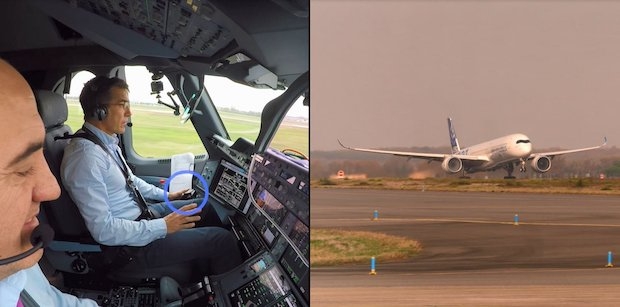
Airbus has successfully performed the first fully automatic vision-based take-off using an Airbus Family test aircraft at Toulouse-Blagnac airport. The test crew comprising of two pilots, two flight test engineers and a test flight engineer took off initially at around 10h15 on 18 December and conducted a total of 8 take-offs over a period of four and a half hours.
“The aircraft performed as expected during these milestone tests. While completing alignment on the runway, waiting for clearance from air traffic control, we engaged the auto-pilot,” said Airbus Test Pilot Captain Yann Beaufils. “We moved the throttle levers to the take-off setting and we monitored the aircraft. It started to move and accelerate automatically maintaining the runway centre line, at the exact rotation speed as entered in the system. The nose of the aircraft began to lift up automatically to take the expected take-off pitch value and a few seconds later we were airborne.”
Rather than relying on an Instrument Landing System (ILS), the existing ground equipment technology currently used by in-service passenger aircraft in airports around the world where the technology is present, this automatic take-off was enabled by image recognition technology installed directly on the aircraft.
Automatic take-off is an important milestone in Airbus’ Autonomous Taxi, Take-Off & Landing (ATTOL) project. Launched in June 2018, ATTOL is one of the technological flight demonstrators being tested by Airbus in order to understand the impact of autonomy on aircraft. The next steps in the project will see automatic vision-based taxi and landing sequences taking place by mid-2020.
Airbus’ mission is not to move ahead with autonomy as a target in itself, but instead to explore autonomous technologies alongside other innovations in areas such as materials, electrification and connectivity. By doing so, Airbus is able to analyse the potential of these technologies in addressing the key industrial challenges of tomorrow, including improving air traffic management, addressing pilot shortages and enhancing future operations. At the same time Airbus is leveraging these opportunities to further improve aircraft safety while ensuring today’s unprecedented levels are maintained.
For autonomous technologies to improve flight operations and overall aircraft performance, pilots will remain at the heart of operations. Autonomous technologies are paramount to supporting pilots, enabling them to focus less on aircraft operation and more on strategic decision-making and mission management.
Daher Aircraft announced the delivery of a Kodiak 900 to Swiss owners Roland and Claudia Primus, who plan to use the aircraft for adventure flying to remote and short-runway destinations. Their travel...
Qantas Freight and Australia Post have entered the next chapter of their long-standing partnership with the arrival of the first of three additional Airbus A321 Passenger-to-Freighter (A321P2F) aircra...
In business aviation, exceptional service is defined by attention to detail, and few amenities reflect that more clearly than premium catering. At the intersection of hospitality and private aviation,...
The U.S. Federal Aviation Administration has certified the Boeing 737-10, the newest and largest member of the 737 MAX family, paving the way for Boeing [NYSE: BA] to begin customer deliveri...