

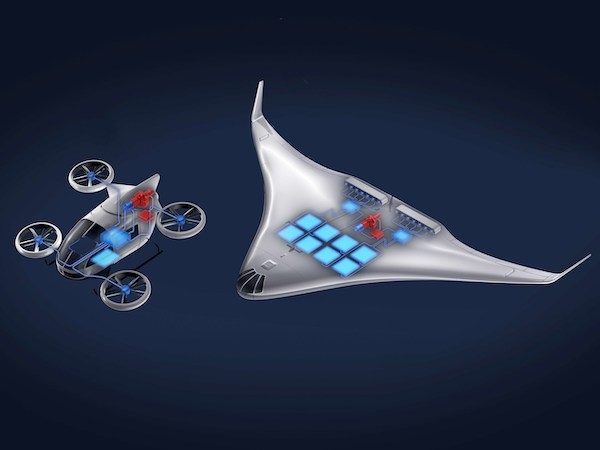
Significant progress by Pratt & Whitney and Collins Aerospace on advancing hybrid-electric propulsion through the Scalable Turboelectric Powertrain Technology demonstrator, which completed its first engine run and electrical system integration test. As a modular and scalable demonstrator platform, STEP-Tech is intended for rapid prototyping of distributed propulsion concepts applicable to a wide range of next generation applications, including advanced air mobility vehicles, high-speed eVTOL and blended wing body aircraft.
Mark Russell, Chief Technology Officer, RTX, commented: "Hybrid-electric propulsion is a key part of RTX's roadmap for enabling more sustainable aviation, with the potential to enhance efficiency across many future aircraft applications, from advanced air mobility to regional aircraft and single-aisles.Harnessing deep expertise from Pratt & Whitney, Collins Aerospace and Raytheon Technologies Research Center in the fields of both aircraft propulsion and electrical systems, RTX is leading the development of hybrid-electric technology through multiple demonstration programs, including STEP-Tech."
Conducted at the Raytheon Technologies Research Center in East Hartford, Connecticut, the successful test included the first run of STEP-Tech's turbogenerator loaded at partial power. This was followed by an electrical system test where the battery and supercapacitor energy storage systems were integrated with the high voltage distribution system. STEP-Tech will next progress testing to a full-power turbogenerator run and validation of the electric fans (propulsors) through the high voltage electrical system.
RTX is also advancing hybrid-electric propulsion as part of its hybrid-electric flight demonstrator program, supported by the governments of Canada and Quebec, and the Sustainable Water-Injecting Turbofan Comprising Hybrid-Electrics (SWITCH) consortium, supported by the European Union's Clean Aviation Joint Undertaking.
These demonstrator programs are part of a companywide strategy to develop a broad portfolio of sustainable aviation technologies, leveraging collaboration across RTX's business units and through wider industry and public-private partnerships. The strategy recognizes the importance of continually advancing aircraft efficiency and enabling wider use of Sustainable Aviation Fuels to support the industry's goal of achieving net-zero CO2 emissions for civil aviation by 2050.

Archived
3 years ago
Bristow Group Inc., in partnership with Electra, Avinor and the Norwegian Civil Aviation Authority (CAA Norway), will undertake a series of demonstration flights across five locations in Norway using...
The U.S. Federal Aviation Administration has certified the Boeing 737-10, the newest and largest member of the 737 MAX family, paving the way for Boeing [NYSE: BA] to begin customer deliveri...
TARMAC Aerosave has set a new industry benchmark by becoming the first company in the world to secure Aircraft Fleet Recycling Association (AFRA) accreditation across all three scopes of aircraft disa...
Airbus 2026 Cargo Global Market Forecast, unveiled at the Cargo Facts Symposium, predicts that the global fleet of dedicated freighter aircraft will expand by 46%, rising from 2,360 aircraft in 2026 t...