


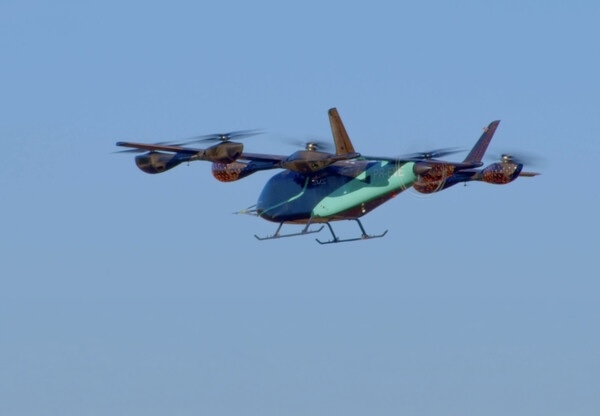
Eve Air Mobility completed its first partial transition flight, marking an important milestone in the development and testing of the company' eVTOL aircraft. The flight involved the activation of the aircraft's rear pusher propeller and thus signified the start of the transition phase from vertical to wing-borne flight. During the test, the aircraft attained a stabilized speed of 27 knots and a maximum ground speed of 30 knots whilst the pusher was activated up to 1,200 RPM. The flight took 3 minutes and 9 seconds, travelled approximately 0.84 nautical miles and attained a maximum height of 90 feet above ground level.
Johann Bordais, chief executive officer of Eve Air Mobility commented: "This first partial transition flight is an important milestone in Eve's development journey. Successfully activating the pusher propulsion system in flight validates a key aspect of our aircraft design and brings us one step closer to delivering safe, efficient and scalable air mobility solutions."
Marcelo Basile, head of engineering at Eve Air Mobility stated: "This flight successfully demonstrated pusher activation in flight and validated key performance targets at the start of the transition phase. The data collected will support continued envelope expansion as we advance toward higher speeds and more complex transition flight testing."

The transition phase is one of the most critical aspects of eVTOL flight, as it involves the aircraft moving from vertical lift to forward flight. The successful completion of this initial partial transition test further advances Eve’s efforts to expand the aircraft’s flight envelope and validate system performance.
Eve’s flight test engineering team is continuing ongoing loads and structural analyses to support future envelope expansion. Following the aircraft’s flight-testing program, the company plans to conduct datalink testing to validate radio link performance and support operations at speeds up to 50 knots.
Over the coming weeks, Eve expects to progressively expand the aircraft’s airspeed envelope, including additional flights with pusher activation as part of the broader transition flight-test campaign.


A Discover Airlines Airbus A330 has become the first Airbus aircraft worldwide to enter regular commercial service after undergoing a full-scale AeroSHARK retrofit, marking a signi...
Bombardier marked the 40th anniversary of its industry-leading Smart Services cost-per-flight-hour programs, which today support more than 1,500 enrolled aircraft and account for over 11 mil...
BPE Air, the aviation company founded and wholly owned by entrepreneur Aldrew Crowe, reported approximately US$90 million in revenue in 2025, marking a major milestone in the growth of its integrated...
Velocity Maintenance Solutions, an FAA-certified provider of maintenance, repair and overhaul services, has announced a significant expansion of its facilities at Wilmington Airport (ILG) in Delaware,...