


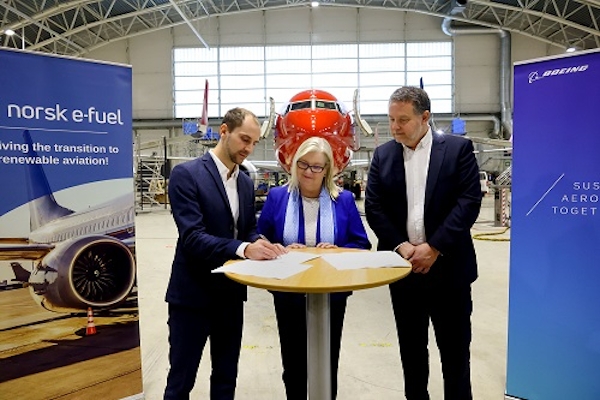
Boeing became a key project development partner of Norsk e-Fuel, supporting one of Europe’s first industrial scale Power-to-Liquids facilities. Boeing investment will accelerate the production and availability of sustainable aviation fuel in the Nordics and globally. It is also intended to support the commercial aviation industry’s and ICAO member states’ common goal to achieve net-zero carbon emissions by 2050.
Norsk e-Fuel will produce jet fuel known as electro-SAF, or e-SAF. This involves the PtL process: using fossil-free power to generate green hydrogen and combining it with recycled CO₂ from biogenic sources. This fuel can reduce the lifecycle greenhouse gas emissions of air travel by over 90% compared to conventional jet fuel.
Steve Gillard, Boeing’s regional sustainability director for Europe, Middle East, Türkiye, Africa and Central Asia commented: “Our support of and collaboration with Norsk e-Fuel underscores the importance of using fossil-free energy to accelerate SAF production, which is key to reducing aviation’s carbon emissions towards 2050. Our partnership to advance e-fuels will help mobilize the commercialization of SAF in the Nordics and across the world, increasing accessibility and availability for our customers as we help build a robust SAF ecosystem.”
Lars Bjørn Larsen, CCO of Norsk e-Fuel stated: “Our goal is to make e-fuels competitive with and eventually replace fossil fuels in critical infrastructures as SAF needs to become readily accessible and affordable for advancing aviation’s decarbonization. Boeing’s investment will further accelerate our project pipeline and will facilitate the broader aviation industry’s transition to net-zero emissions.”
It is estimated that SAF accounted for only 0.53% of the global commercial fuel use in 2024. In Europe, the Refuel EU SAF initiative’s proposed mandate aims to gradually increase the share of SAF, reaching a target of 6% by 2030, and 70% by 2050. There are also sub-mandates for e-SAF, such as that produced by Norsk e-Fuel, with targets of 1.2% in 2030 increasing to 35% in 2050.
Boeing’s investment will contribute to achieving the SAF volumes needed by the EU commitments and strengthen national energy security across the Nordics. The partnership will also inform policies that enable the economic viability of the global SAF industry, while supporting long-term competitiveness of the aviation industry in the region. The strategic partnership combines Boeing’s SAF industry leadership and fuels expertise with Norsk e-Fuel’s technology know-how and strong network of partners, including Norway’s largest air carrier, Norwegian.
Geir Karlsen, CEO of Norwegian said: “We are pleased to welcome Boeing on board. Their investment marks a significant milestone for Norsk e-Fuel and confirms the positive development we have had. We look forward to leveraging Boeing’s expertise and experience in the development and growth of this pioneering industry. This investment also reinforces the need for a supportive policy environment to fully realise the potential of e-fuels production in Norway, in line with the Norwegian parliament’s call.”

Airbus 2026 Cargo Global Market Forecast, unveiled at the Cargo Facts Symposium, predicts that the global fleet of dedicated freighter aircraft will expand by 46%, rising from 2,360 aircraft in 2026 t...
In business aviation, exceptional service is defined by attention to detail, and few amenities reflect that more clearly than premium catering. At the intersection of hospitality and private aviation,...
Bombardier marked the 40th anniversary of its industry-leading Smart Services cost-per-flight-hour programs, which today support more than 1,500 enrolled aircraft and account for over 11 mil...
Bristow Group Inc., in partnership with Electra, Avinor and the Norwegian Civil Aviation Authority (CAA Norway), will undertake a series of demonstration flights across five locations in Norway using...