


According to a survey commissioned by Airbus Corporate Jets of senior executives of U.S. businesses with an annual revenue of over $500 million whose companies use private jets, 57% state half or more of their flights are carbon offset. Within three years, they expect the figure to be 67%. All of the U.S. business executives interviewed in ACJ’s study who work for organizations that own their own private jet believe their companies will eventually insist on only using SAF for their aircraft. As SAF becomes more affordable, 58% of those senior executives interviewed who work for companies with their own private jets said this will lead to a dramatic increase in their use, and 32% expect a slight increase.
Sean McGeough, VP Commercial ACJ for North America, commented: “Businesses in the U.S. place a huge focus on reducing the environmental impact of their flights, and this will increase in terms of offsetting, but also in the measures taken to reduce carbon emissions. Advances in SAF will be key to this.”
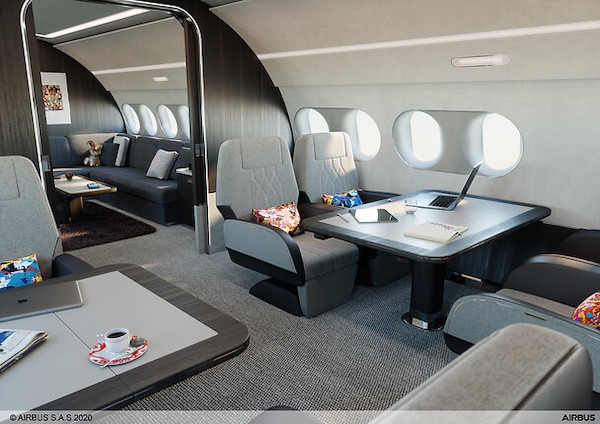
Airbus is committed to pioneering the use of sustainable fuel, but also to developing the latest technology to reduce the impact of our aircraft on the environment. For example, its new ACJ TwoTwenty business aircraft uses advanced materials and technology for lower fuel burn and maintenance costs. It has 50% lower emissions per square meter when compared to large business jets in general.
ACJ offers a range of large business aircraft, the latest of which is the ACJ TwoTwenty. This new jet was launched in October 2020, creating a whole new market segment – ‘The Xtra Large Bizjet.’
The ACJ TwoTwenty offers unbeatable economics and unrivaled reliability at the same price as ultra-long-range (ULR) business jets. It occupies the same parking footprint as competitive ULR jets and can take off from the same airports, but its operating costs are one-third less. It also is the quietest and most eco-friendly aircraft in its category.



A professional training device such as the new PC-12 PRO simulator is built on flight data supplied and validated by Pilatus. Drawing on actual flight-test and performance data, it accurately reproduc...
Archer Aviation has unveiled plans to develop three air taxi networks across Austin, Dallas-Fort Worth and Houston, aiming to improve connectivity between major airports, business centers and key regi...
Cirrus Aircraft has broken ground on a new 15,000-square-foot Engine Run-Up Center that will centralize engine testing, fuel calibration and certification activities for the SR Series, Vision Jet and...
Asco, a subsidiary of Montana Aerospace AG, achieves significant technological milestone in the development of a hybrid multi-material Rear Secondary Structure for Airbus. Montana Aerospace,...