


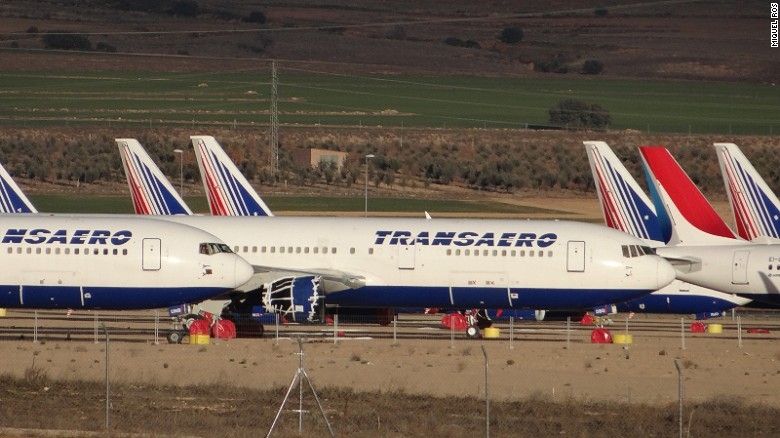
On a cold, dry plain in rural eastern Spain, 1,000 meters above sea level, a surreal scene greets drivers speeding along the Mudejar Highway inland from the Mediterranean sea.
Line after line of enormous jumbo jets appear silhouetted against the horizon.
It's not a mirage, but the site of the largest industrial airport in Europe.

Don't call it a junkyard
Located outside the town of Teruel, the smallest of all Spanish provincial capitals, this is not a typical airport.
There are no check-in desks, departure lounges, luggage carousels, coffee shops, taxi stands or shuttle buses.
For the simple fact that there are no commercial flights here -- and there never were.
This airport was built with other purposes in mind.

It hosts aircraft from all over the world that have been withdrawn from service, be it temporarily or permanently, and caters to their maintenance needs.
What it's not, however, is an aircraft junkyard.
Some aging airliners may be scrapped here (after being stripped for valuable parts and spares) but plenty of new, perfectly serviceable aircraft are stored in Teruel.
Some are ready to fly but are waiting for financial or legal issues to be sorted out.
Some are here because their airlines need to temporarily adjust capacity to cope with fluctuating market conditions.

Other activities
Teruel isn't just a storage facility.
Director Alejandro Ibrahim says it's also home to a whole range of other aviation-related activities, including those in fields with high growth potential.
"Since the airport opened we have already welcomed a company testing rocket engines, he says. "We have been active in the field of drone research and we will soon have also a pilot training center here."
There are few such storage facilities on the planet.

There's the Mojave Air and Space Port, in the Californian desert, where the arid climate creates an ideal environment for plane storage.
Another near Pau, in southern France, has run out of space, so its managing company,Tarmac Aerosave, is looking for other locations -- Teruel being an obvious choice.
This type of facility requires a lot of free land -- something Teruel has in abundance.
The airport's located in a corner of Spain so sparsely populated that in recent years locals launched a public investment campaign using the slogan "Teruel existe" ("Teruel exists").
For storing aircraft though, it's perfect.
It has a dry continental climate and a relatively accessible location -- between Barcelona, Madrid and Valencia.

Russian connection
Demand for aircraft storage has been driven by the meteoric growth of the global airliner fleet following two decades of industry liberalization.
Juan Manuel Gallego, engineer and CEO of aviation consultancy firm ICARUM, says sudden contractions in aircraft demand mean the operations like Teruel are regularly called upon.
"The dynamism of the airline industry leads to a substantial number of aircraft needing storage facilities at any one time, either because of obsolescence or because airlines are constantly seeking efficiency improvements through fleet renewal and optimization," he says.
On top of this, Gallego says, non-passenger related activities are being pushed out of major hub airports, as space is at a premium and passengers tend to be more profitable.
An unexpected additional factor has also played a key role in the Spanish airport's meteoric growth and consolidation: the Russian economic crisis.

Near capacity
Transaero and UTAir, the second- and fourth-largest Russian airlines, had a terrible 2015, with the latter axing most of its fleet and the former ultimately ceasing operations.

The result has been an influx of Russian airliners of all types, some of them almost new from the factory, that has brought the airport to near capacity.
A further expansion of the airport grounds, that will allow for over 200 airliners to be stored simultaneously, is already being planned.

Photo opportunity
Some aviation enthusiasts might find it heartbreaking to see nearly a hundred airliners, including quite a few magnificent Boeing 747s, standing idle, quietly awaiting their fate.
While some others may relish the unparalleled opportunities for plane-spotting and to capture this unusual spectacle on camera.
Viasat has significantly expanded the capacity of its JetXP in-flight connectivity service across the United States, delivering up to five times more bandwidth for business aviation customers equipped...
Turkish Airlines has taken another major step in its fleet expansion strategy with the signing of a Memorandum of Understanding with CFM International for more than 300 LEAP-1B engines and a long-term...
Few infrastructure projects have the potential to reshape an island's future quite like the ongoing transformation of Nevis Airport. To gain deeper insight into this ambitious development and the...
Qantas Freight and Australia Post have entered the next chapter of their long-standing partnership with the arrival of the first of three additional Airbus A321 Passenger-to-Freighter (A321P2F) aircra...