


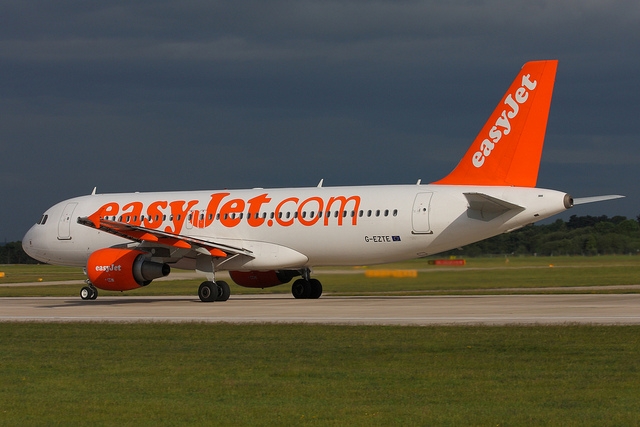
UK investigators have reiterated the need to understand aircraft behaviour in various modes after the stall-protection system intervened on an EasyJet Airbus A320 during a visual approach to Paphos.
It had been conducting a left-hand circuit to runway 29, following a service from London Luton on 7 January last year.
The aircraft had been cleared to descend from 4,000ft to 1,500ft and the crew was using ‘open descent’ mode on the A320, with the engines at idle thrust and the autopilot maintaining a target speed using pitch.
When the first officer, who was flying, started the base turn he disconnected the autopilot. But the captain was pre-occupied by a radio call and a subsequent instruction to turn off the flight director was “overlooked”, says the UK Air Accidents Investigation Branch.
With the flight director left on, the aircraft crucially remained at idle thrust. To maintain airspeed the pilot needed to follow the flight director’s pitch commands.
“Thrust will not increase when the pitch commands are not followed and there is a decay in speed, until the low-speed protections activate,” says the inquiry.
“Flight crew are accustomed to the speed protections afforded by the [autothrust] and…if misunderstood, there can be an expectation that the [autothrust] will vary the thrust to maintain the target speed.”
The A320 had turned onto the base leg while descending through 3,100ft at 165kt.
But as the aircraft turned, the first officer stated that the airspeed was decaying. It descended through 2,680ft with airspeed just 5kt above the lowest selectable – a threshold which provides a margin to the stall speed – at 12° nose-up pitch and a high angle-of-attack.
The airspeed continued to decay, to 2kt below lowest selectable, and the first officer focused on the speed situation.
“In the turn, the pitch attitude increased and the rate of descent decreased, leading to a further reduction in airspeed,” says the inquiry, adding that this triggered the automatic stall-protection system.
The inquiry notes that the first officer had made aft sidestick inputs despite the reduction in airspeed, indicating that he was losing situational awareness.
With the aircraft pitched 10.5° nose-up and climbing through 2,900ft, the first officer handed control to the captain. The captain was startled by the decision, and had to assess an unexpected situation, but the crew subsequently initiated a missed approach and regained control of the aircraft.
Although the pilots had received specific training on automation modes, and the first officer had been made aware of risks associated with ‘open descent’, the inquiry says the crew demonstrated a “breakdown in procedures” and a “lack of appropriate reaction” to the airspeed reduction.
EasyJet had previously provided a programme of automated flight-mode awareness simulator training but, following the Paphos incident, additional procedures involving mode announcement have been introduced.
Bombardier marked the 40th anniversary of its industry-leading Smart Services cost-per-flight-hour programs, which today support more than 1,500 enrolled aircraft and account for over 11 mil...
Few infrastructure projects have the potential to reshape an island's future quite like the ongoing transformation of Nevis Airport. To gain deeper insight into this ambitious development and the...
BPE Air, the aviation company founded and wholly owned by entrepreneur Aldrew Crowe, reported approximately US$90 million in revenue in 2025, marking a major milestone in the growth of its integrated...
Archer Aviation has unveiled plans to develop three air taxi networks across Austin, Dallas-Fort Worth and Houston, aiming to improve connectivity between major airports, business centers and key regi...